
Insights & Ideas
HUL’s 300,000-Creator Bet Shows Influencer Marketing Isn’t Slowing Down
For years, influencer marketing has lived under one constant question. Is this sustainable? Is it just a phase? Is the bubble going to burst?
And then a company like Unilever quietly answers it. Not with a statement. With a number.
3,00,000.
This isn’t scaling. This is a shift
In just two years, Unilever expanded its influencer network from around 10,000 to nearly 3,00,000 creators globally. That’s not experimentation but commitment. More importantly, it’s a signal that influencer marketing is no longer being treated as a campaign lever. It’s becoming infrastructure.
From “working with creators” to building systems around them
Earlier, brands worked with creators. Now, they’re building ecosystems. Unilever’s approach isn’t about finding a few big names. It’s about creating a network of people - creators, professionals, even everyday users - who talk about the brand in their own way.
It’s less about control.
More about distribution.
Less about messaging.
More about recommendation.
The real insight: trust has moved
There’s a line that captures this shift perfectly. Traditional brand messaging is starting to feel…suspicious. And that’s not an exaggeration.
Consumers today are far more likely to trust:
- a creator explaining a product
- a friend recommending something
- a random review on social media over a polished brand ad.
Unilever isn’t creating 3,00,000 pieces of content. It’s building 300,000 points of trust.
This also explains why scale now looks different
Scale in advertising used to mean reach. Now it means repetition across people.
Not one big ad seen by millions but thousands of smaller conversations happening at once. That’s harder to control. But far more believable.
Influencer marketing isn’t peaking. It’s expanding
If anything, this move makes one thing clear. We’re still early.
Because what we’ve been calling “influencer marketing” so far has mostly been:
- campaigns
- brand deals
- one-off collaborations
What’s coming next looks more like:
- always-on creator ecosystems
- long-term brand advocacy
- distributed storytelling
And that’s a very different game.
The uncomfortable part
More creators doesn’t automatically mean better content. It means more noise, more sameness and more average content flooding feeds.
But brands seem okay with that trade-off. Because even within that noise, trust travels faster when it comes from people.
So what does this really mean?
It means influencer marketing isn’t going anywhere. It’s just changing shape.
From a tactic to a system and from campaigns to culture. And when a company built on decades of traditional advertising starts behaving like this…it’s usually not a trend. It’s a direction.
All Blogs
Anyone who has worked in marketing knows one universal truth: campaigns rarely move fast.
Decks circulate. Scripts bounce between teams. Timelines stretch. Holi comes and goes. But occasionally, a campaign runs on a completely different clock.
That’s exactly what happened with Kissan’s latest creator-led Holi campaign - executed by Monk Entertainment - which went from a closed deal to a live piece of content in roughly a week.
Not a week to start.
A week to finish.
A Holi Conversation Between Generations
The film itself leans into a familiar cultural tension: the eternal banter between GenZ and millennials.
At the centre of it is Aaditya Kulshreshth - better known to internet audiences as Kullu - who takes on the role of the resident GenZ guide preparing three slightly confused millennials for what he calls a “GenZ Holi party.”
Those millennials happen to be comedians Rahul Subramanian, Rohan Joshi and Kumar Varun, and the chemistry between the three drives the entire piece. The setup is simple but effective.
While the older duo imagines a Holi gathering with the usual suspects - misal, pakode, sev puri - Kullu interrupts their nostalgic fantasy with a dose of GenZ reality. This isn’t that kind of party, he tells them.
Think sushi.
Think experimental menus.
Think “eat before you arrive.”
Cue the pre-party food arriving for the trio: samosas and other comfort snacks. But then comes the obvious question - where’s the chutney?
That’s when the generational shift sneaks into the script. Instead of the old-school routine of grinding chutney at home, Kullu casually reminds them that this is 2026. Quick-commerce exists. A few taps later, Kissan chutney is on its way via Zepto, and the trio finally settles down to eat before heading out to play Holi.
It’s a small moment, but it neatly captures what the campaign is really about: how everyday rituals evolve with technology-and how brands quietly slip into those transitions.
A Timeline That Would Make Most Campaign Managers Nervous
The more interesting story, however, isn’t just what appears on screen. It’s how quickly the entire thing came together.
The campaign moved at a pace that would normally be considered unrealistic in the marketing world:
Wednesday - Deal closed
Friday - Script locked
Sunday - PPM
Monday - Shoot
Wednesday - Campaign live
In other words, the entire campaign -from handshake to Instagram - was executed within a single week.
That kind of turnaround is rarely possible without tight coordination across creators, production teams and brand stakeholders. Which is where Monk Entertainment’s role becomes central.
The agency handled the campaign end-to-end, from ideation to creator alignment to production and delivery.
When timelines shrink this dramatically, the margin for chaos grows. What keeps things intact is a team that already understands how creators work, how social content needs to feel, and how to move from concept to shoot without overthinking every frame.
Why Speed Matters More Than Ever
In the influencer marketing world, speed isn’t just operational efficiency-it’s creative currency. Festivals like Holi live in short cultural windows. Miss the moment and the campaign loses its relevance.
Creator-led campaigns, especially those built on humour and cultural observation, work best when they feel timely rather than over-produced. That’s the advantage of a model where the same team handles ideation, creator partnerships and execution.
Instead of passing the brief across multiple vendors, the campaign moves through one pipeline. And sometimes that means a script locked on Friday becomes a reel in people’s feeds the following Wednesday.
The Takeaway
The Kissan Holi campaign works because it doesn’t try too hard.
Three creators. A generational joke everyone recognises. A quick-commerce moment that feels believable. And a brand integration that lands without announcing itself. But behind that casual tone sits something more operationally impressive: a campaign that went from concept to screen in a matter of days.
In a marketing ecosystem that often moves slowly, this one moved at internet speed. And sometimes, that’s exactly what the moment calls for.
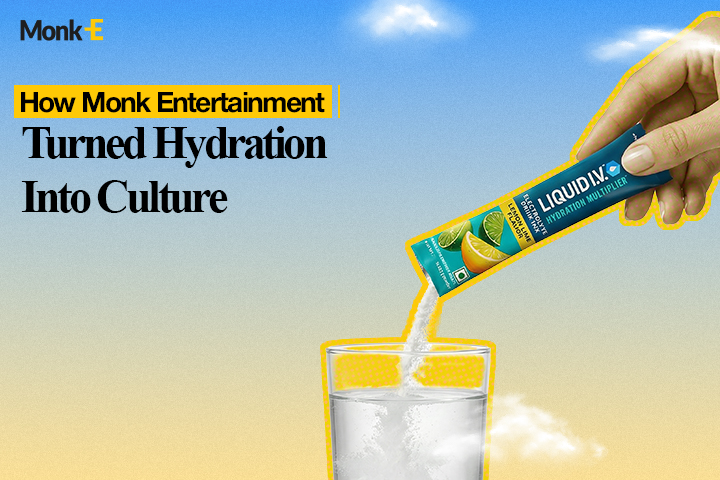
Let’s be honest - hydration isn’t exactly the sexiest topic on social media. Until it suddenly is.
Somewhere between GRWM reels, everyday chaos and creator humour, Liquid IV quietly made hydration feel cool. Not gym-bro cool. Not doctor-prescription cool. Just…scroll-worthy cool.
If someone told you last year that osmolarity would become Instagram content, you’d probably laugh and scroll away.
And yet - here we are.
Liquid IV managed to turn a clinical hydration concept into something unexpectedly entertaining, thanks to three creators, a sharp creative lens, and an execution strategy that leaned heavily on humour over hard selling.
The campaign, ideated and executed by Monk Entertainment, didn’t explain hydration like a textbook. It explained it like life - messy, funny, sarcastic and painfully relatable.
Where Science Meets Everyday Analogies
Instead of starting with product benefits, the campaign starts with situations.
Anuj Gupta breaks down osmolarity through relationship dynamics. Maheep Singh brings his signature observational humour into a classroom-style setup. And Apoorva (The Rebel Kid) does what she does best - blending sarcasm with chaotic honesty.
Each video takes a familiar setting - love, education, everyday exhaustion - and uses it to explain why how you hydrate matters, not just that you hydrate. The science shows up. But it never takes centre stage. Instead, osmolarity becomes the punchline.
And that’s exactly why it works.
Comedy First. Product Second.
What’s refreshing about this campaign is how comfortably Liquid IV sits inside the content.
There’s no dramatic product reveal. No forced call-to-action energy. The creators walk audiences through funny, exaggerated scenarios - and only then introduce Liquid IV as the “right” way to hydrate. It feels less like advertising and more like someone finally explaining something complicated without sounding smug.
That balance doesn’t happen by accident.
It comes from understanding creator tone, audience psychology and platform behaviour - something Monk Entertainment’s influencer marketing work consistently leans into. Rather than bending creators to fit a brand script, the brand adapts to creator personality. Which is exactly how modern influencer marketing should work.
Where The Campaign Gets It Right
Audiences today don’t mind being marketed to. They mind being bored.
This campaign taps into what’s becoming increasingly clear across influencer marketing in India: educational content performs best when it’s wrapped in entertainment. Especially when it doesn’t pretend to be perfect.
The reels feel human. Slightly chaotic. Comfortably sarcastic. And that’s what makes viewers stay.
Instead of polished “explainer videos,” Liquid IV shows up through humour-led storytelling - letting creators translate technical information into cultural language.
It’s not about simplifying the science.
It’s about contextualising it.
The Monk Entertainment Effect: Connecting Strategy With Storytelling
From creator selection to narrative flow, the campaign carries a quiet consistency. Different creators. Different settings. Same underlying idea.
That cohesion comes from having ideation and execution under one roof - something Monk Entertainment handled end-to-end for this campaign. Not by over-directing creators, but by anchoring them to a strong central thought. It’s a reminder that great creator campaigns aren’t built on spreadsheets alone. They’re built on creative alignment.
The Bigger Takeaway
Liquid IV didn’t win attention by shouting louder. It won by explaining osmolarity through relationships, classrooms and everyday exhaustion - and trusting creators to do what they do best.
And Monk Entertainment didn’t manufacture influence. They simply gave it structure.
In a creator economy where everyone is chasing virality, this campaign proves something far more valuable: Sometimes, the smartest way to sell science is with sarcasm.
Scene 1: The “It’s Just a Reel, Right?” Illusion
Ah yes, the world’s most misunderstood sentence: “You just post videos.”
If only.
A 30-second Reel = 3 hours of ideation, scripting, shooting, editing, captions, hashtags, re-edits, thumbnail changes, brand approvals, and anxiety over “why is this stuck at 2,843 views?”
The irony? The better it looks, the harder it was.
According to The Creator Burnout Report by Viral Nation, 52% of creators report burnout, and 37% are considering leaving their careers altogether.
Behind every “effortless vibe” video is a full production team of one person - you.
Scene 2: The Cost of “Aesthetic”
Let’s talk numbers, not filters.
Creators don’t just invest time - they invest in a lifestyle that looks like the job they want.
Cameras, tripods, mics, editing software, ring lights, props, outfits, setups, and café coffees labeled “shoot day essentials.”
As per industry leaders, a mid-tier Indian creator spends anywhere between Rs 15,000-Rs 50,000 a month on equipment, aesthetics, and ad-hoc production costs.
It’s like being your own ad agency - only you’re the intern, the boss, and the brand face.
Scene 3: The Mental Gym Nobody Talks About
Every creator’s brain runs on a dual-core system:
● Algorithm anxiety (“Did I post too late?”)
● Comparison syndrome (“Why did their ‘get ready with me’ get 500k?”)
Constant self-surveillance - every post is a report card.
Even rest days feel like guilt trips.
The MBO Partners Creator Economy Trends Report 2024 found that “almost half (46 %) of independent creators reported it’s hard to be successful in the creator economy, and 41 % said they struggle with burnout.”
This isn’t vanity - it’s visibility fatigue.
Scene 4: The “Brand Deal” Myth
Let’s debunk the holy grail of influencer life - the brand collab.
Sure, the Rs 50K campaign looks glamorous, but behind it?
● 12 back-and-forth emails
● 3 revised captions
● 1 unpaid “bonus deliverable”
● 1 delayed payment
And here’s the kicker: Even with India’s booming creator economy, 88% of content creators still earn less than 75% of their income through social media, and over half make under 25% of their total earnings from digital content, as per Kofluence’s Annual Research Report 2024-25.
Most are juggling multiple gigs just to afford the “creator life” people think they’re rich from.
Scene 5: The Burnout Paradox
Creators often don’t quit because they’re tired - they quit because they no longer recognise themselves.
One viral post can skyrocket your reach but wreck your rhythm.
The better you perform, the more the audience expects.
And soon, you’re no longer creating for joy - you’re creating to maintain momentum.
Many call it “success stress.” Creators start equating “being loved” with “being visible.”
Scene 6: The Agency Angle - The Backstage Enablers
Here’s what brands and influencer agencies often miss:
Creators aren’t deliverables - they’re creative humans operating on emotional bandwidth.
When brands micromanage, underpay, or expect overnight drafts, they aren’t just killing creativity - they’re devaluing the product and the person.
Agencies like Monk-E are beginning to prioritise wellness check-ins and creative flexibility - because a burnt-out creator can’t sell authenticity, no matter how good the lighting.
Scene 7: The Real ROI - Rest Over Influence
We romanticise hustle, but burnout has no aesthetic.
It doesn’t photograph well.
Creators who sustain are the ones who set boundaries - the ones who post less but live more.
Because real influence doesn’t come from posting daily.
It comes from having something real to say.
End Credits
Influence may look like luxury.
But behind the gloss lies grind, behind the likes lies labour.
So the next time someone says, “Must be nice to be an influencer,”
show them your unpaid invoices, your 48-hour edit timeline, and your draft folder titled ‘Burnout but make it content.’
That’s the real influencer economy - powered by invisible work, visible passion, and the quiet chaos of creation.
The Pre-Fame Phase - Your Mom Is Still Your Only Follower
You post your first Reel. It gets 17 views, 2 likes, and both are from your cousins.
You question life, your camera quality, and maybe your destiny.
Welcome to the Nano Era.
This is where the magic actually starts - where you build your identity before you build your audience.
Find your tone. Test your filters. Overshare strategically.
#Tip: Don’t aim for viral. Aim for memorable. People forget trends; they remember tone.
The Nano Hustle - 0 to 10K Followers
You’re in the DMs of PR people like it’s a part-time job. You’ve done three barter deals and one “exposure” post (and yes, exposure doesn’t pay rent).
But this is your brand internship phase.
Brands start noticing you for your authenticity, not your analytics. You’re still relatable, reachable, and a bargain.
#Tip: Don’t underprice yourself forever. Even your passion deserves a rate card.
#Sub-tip: But your rate card isn’t laminated - it evolves.
The Micro Moment - 10K to 50K Followers
Suddenly, PR agencies know your first name. Your free hampers double, and so does your imposter syndrome.
This is where creators either blow up or burn out.
You’ve found a voice, but the algorithm starts flirting with someone else. So you pivot, post more, stress-scroll, and learn your first professional truth:
Consistency isn’t about posting daily. It’s about showing up even when you hate your draft.
#Tip: This is your “networking era.”
Attend events. DM other creators. Collaborate. Visibility > virality.
The Mid-Creator Crisis - 50K to 150K
You’re now in the sweet spot where brands pay, but not always fairly. Your management starts saying words like deliverables, KPI, and brand tonality and you smile politely while Googling what they mean.
You’ve officially graduated to professional creator territory.
But with brand briefs come brand boxes - “Could you make this sound a little more you, but also like everyone else?”
#Tip: You can’t scale what you don’t own.
Don’t let your niche define you; let your narrative do that.
The Macro Mirage - 150K to 500K Followers
This is where you look successful but still feel broke.
Half your money goes to stylists, videographers, and coffee bills at Soho House.
You’re now “aspirational” - which is code for “expensive but exhausted.”
Brands now brief you 4 months in advance and still ghost you on payments. Welcome to the paradox: you’re visible everywhere, but chasing fewer things that matter.
#Tip: Don’t chase numbers. Chase nostalgia.
The bigger you get, the smaller your connection feels - fix that.
The Collab Class - Where Brands Start Speaking Your Language
You’ve stopped saying “Yes” to everything.
You’ve realised not every product deserves your face (or feed). And brands now approach you with co-creation, not collaboration.
You’re not the influencer - you’re the IP.
#Tip: This is where the word “strategy” enters your bio.
Own your audience. Build a newsletter, community, or merch. Monetise your influence, not your Instagram.
The Legacy Loop - When You Stop Posting Just for Likes
You’ve seen creators come and go. You’ve stopped chasing trends - you set them now.
Your followers don’t just double-tap; they trust you.
And that’s when you realise - influence isn’t about being famous. It’s about being remembered.
#Final Tip: The best creators don’t just grow followers. They grow faith.
Remember when “influencer” meant “fashion blogger with 10K followers”? That era feels quaint. In 2025 India, influence is industry-specific, niche-charged, and brand-friendly. Brands aren’t just choosing influencers; they’re choosing categories- verticals that deliver trust, context, and ROI.
The creator economy isn’t one monolith anymore- it’s a mosaic of niches chasing big deals.
The Context You Need
India’s influencer marketing industry was estimated at ₹3,600 crore in 2024, and is projected to grow by 25% in 2025. According to the India Influencer Marketing Report 2025, about 70% of brands cited trust & credibility as the top reason for collaborating with creators.
A report from Kofluence estimated India has 3.5 to 4.5 million creators, growing at 22% CAGR. So categories that deliver trust + relevance are what brands are betting on.
The Top Creator Categories Worth Your Attention
Here’s a breakdown of categories where the biggest brand deals are - and why they’re hot right now.
1. Finance & Fin-fluencers
Why it’s booming: In an age of inflation, startup IPOs, and retail investing, everyday Indians are hungry for credible voices on money. Brands from fintech to apps to investment services are flooding this space.
Insights: Brands in the BFSI sector show elevated trust-collaboration metrics.
Worth watching if you’re: A content creator with clarity, numbers, and charisma.
2. Beauty & Skincare
Why it’s booming: Beauty is evergreen, but what’s new is brand differentiation: inclusive voices, real skin stories, and regional focus.
Insights: From the Indian report: manufacturing/beauty brands prioritising content quality (85%) over follower count.
Worth watching if you’re: Comfortable on camera, candid about imperfections, and can talk product + story.
3. Tech & Gadgets
Why it’s booming: With 5G, faster phones, IoT and smart living becoming mainstream in India, creators who can demo, explain, compare quickly are gold.
Worth watching if you’re: Quick with hands-on videos, honest opinions, and a niche test-lab vibe.
4. Food, FMCG & Local Flavours
Why it’s booming: Everyday products need everyday influencers. Tier-2/3 cities are waking up to digital shopping and creators who talk native, regional and relatable are in demand.
Worth watching if you’re: Good at storytelling around everyday behaviour- “how I make this snack” or “regional chai ritual”.
5. Wellness, Fitness & Lifestyle
Why it’s booming: Health is now content. From mental wellness to home workouts to self-care rituals, brands need creators who embody holistic living- not just gym reps.
Worth watching if you’re: Authentic, lifestyle-oriented, and can mix content + story + value.
Why These Categories, Not Others?
Trust orientation: Brands prefer creators who are experts or enthusiasts, not generalists.
Higher wallet-size: These verticals allow premium collaborations (fintech apps, tech launches, wellness brands) so ticket sizes are bigger.
Regional relevance: India’s next wave of growth is outside metros- creators who reflect local flavour get extra bonus.
Content lifespan: A finance explainer or a tech review lives longer and gets reused; the “trend” fashion post gets stale faster.
For Creators: How to Position Yourself
Pick a category you love and can talk about consistently- not just a trend you think will pay.
Build niche expertise: You don’t need millions, you need the right millions for that category.
Document your work: Brands value creators who show their previous collaborations, honest metrics and story arcs.
Invest in credibility signals: Verified links, testimonials, case studies- especially in high-trust categories like finance or tech.
Be plug-and-play: Brands in these verticals hate surprises. If you can deliver script, shot, caption, that’s gold.
Final Takeaway
Influence isn’t one game any more, it’s many verticals. For brands, choosing the right category creator is more strategic than ever. For creators, picking the right category is the gateway to serious brand deals. And for us in the agency ecosystem, it means map the category → pick the creator → scale the authenticity.
Because when brand budgets grow, they don’t just go to more influencers. They go to the right ones.
“We’re Sorry...” Again?
In the past few days, your feed probably looked like a digital confession box. Various brands apologised for being too good. Fashion & lifestyle brands are saying “sorry” for making people “too fashionable.” Snacking brands regretted making snacks “too addictive.” Others followed suit. It was supposed to be witty. It became déjà vu. What started as one clever idea quickly turned into copy-paste creativity. By the fifth apology post, audiences weren’t amused - they were exhausted.
The Trend That Could’ve Been Smart…But Wasn’t
Guessing how it all started? Brands like Škoda India’s “apology letter” - crisp copy, minimalist design, irony done right - had potential.
It spoofed corporate crisis notes while flexing brand confidence. But then everyone else joined in. Same tone, same font, same “oops we’re amazing” format. By Day 3, the internet’s reaction was: “Who are you apologising to, exactly?”
What began as meta became mechanical. Brands forgot that a trend without timing is just noise.
.avif)
The Problem With Over-Optimised Virality
Here’s the truth: not every viral format deserves to be a campaign template. When 10+ brands say the same thing, the irony dies. This trend didn’t build recall - it built repetition. Audiences didn’t remember who started it, they just remembered that everyone sounded the same. And in an era where attention spans last eight seconds, sameness is fatal.
Why This “Sorry” Didn’t Stick
1. No Cultural Context - It wasn’t linked to a moment, cause, or brand truth. Just a format.
2. No Emotion Left - The word “sorry” lost power after being used 50 times in 24 hours.
3. No Risk Taken - Every brand played it safe. Irony without insight.
4. No Conversation - A campaign trend works only when it triggers talk. This one triggered yawns.
When Everyone’s “Sorry,” No One Is
The apology trend is a lesson in over-engineering virality. Marketing isn’t about posting what works for others; it’s about posting what fits your voice. If your brand doesn’t have something meaningful to apologise for, don’t. Because nothing says “we ran out of ideas” like a fake apology that apologises for nothing.
Final Scroll Thought
“Sorry” used to mean sincerity. In 2025, it just means saturation. Maybe next time, brands can skip the template - and say something real. Or better yet, say nothing at all.