
How Monk-E Made Osmolarity Funny (Yes, Really) for Liquid IV
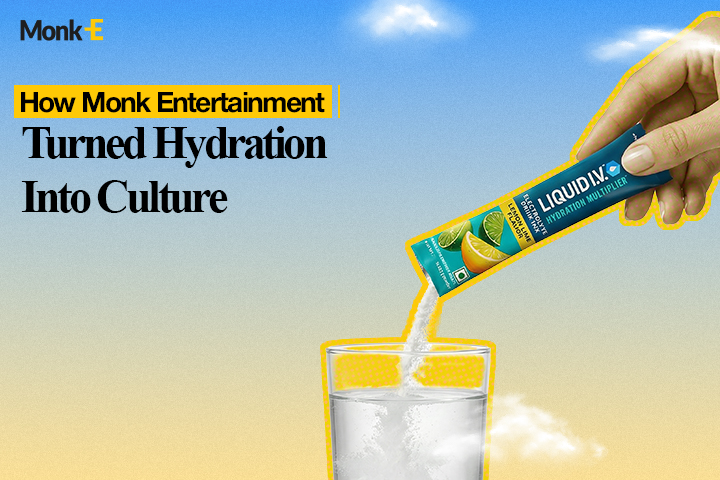


Let’s be honest - hydration isn’t exactly the sexiest topic on social media. Until it suddenly is.
Somewhere between GRWM reels, everyday chaos and creator humour, Liquid IV quietly made hydration feel cool. Not gym-bro cool. Not doctor-prescription cool. Just…scroll-worthy cool.
If someone told you last year that osmolarity would become Instagram content, you’d probably laugh and scroll away.
And yet - here we are.
Liquid IV managed to turn a clinical hydration concept into something unexpectedly entertaining, thanks to three creators, a sharp creative lens, and an execution strategy that leaned heavily on humour over hard selling.
The campaign, ideated and executed by Monk Entertainment, didn’t explain hydration like a textbook. It explained it like life - messy, funny, sarcastic and painfully relatable.
Where Science Meets Everyday Analogies
Instead of starting with product benefits, the campaign starts with situations.
Anuj Gupta breaks down osmolarity through relationship dynamics. Maheep Singh brings his signature observational humour into a classroom-style setup. And Apoorva (The Rebel Kid) does what she does best - blending sarcasm with chaotic honesty.
Each video takes a familiar setting - love, education, everyday exhaustion - and uses it to explain why how you hydrate matters, not just that you hydrate. The science shows up. But it never takes centre stage. Instead, osmolarity becomes the punchline.
And that’s exactly why it works.
Comedy First. Product Second.
What’s refreshing about this campaign is how comfortably Liquid IV sits inside the content.
There’s no dramatic product reveal. No forced call-to-action energy. The creators walk audiences through funny, exaggerated scenarios - and only then introduce Liquid IV as the “right” way to hydrate. It feels less like advertising and more like someone finally explaining something complicated without sounding smug.
That balance doesn’t happen by accident.
It comes from understanding creator tone, audience psychology and platform behaviour - something Monk Entertainment’s influencer marketing work consistently leans into. Rather than bending creators to fit a brand script, the brand adapts to creator personality. Which is exactly how modern influencer marketing should work.
Where The Campaign Gets It Right
Audiences today don’t mind being marketed to. They mind being bored.
This campaign taps into what’s becoming increasingly clear across influencer marketing in India: educational content performs best when it’s wrapped in entertainment. Especially when it doesn’t pretend to be perfect.
The reels feel human. Slightly chaotic. Comfortably sarcastic. And that’s what makes viewers stay.
Instead of polished “explainer videos,” Liquid IV shows up through humour-led storytelling - letting creators translate technical information into cultural language.
It’s not about simplifying the science.
It’s about contextualising it.
The Monk Entertainment Effect: Connecting Strategy With Storytelling
From creator selection to narrative flow, the campaign carries a quiet consistency. Different creators. Different settings. Same underlying idea.
That cohesion comes from having ideation and execution under one roof - something Monk Entertainment handled end-to-end for this campaign. Not by over-directing creators, but by anchoring them to a strong central thought. It’s a reminder that great creator campaigns aren’t built on spreadsheets alone. They’re built on creative alignment.
The Bigger Takeaway
Liquid IV didn’t win attention by shouting louder. It won by explaining osmolarity through relationships, classrooms and everyday exhaustion - and trusting creators to do what they do best.
And Monk Entertainment didn’t manufacture influence. They simply gave it structure.
In a creator economy where everyone is chasing virality, this campaign proves something far more valuable: Sometimes, the smartest way to sell science is with sarcasm.
Read More Articles
When Creators Became Search Engines
A few years ago, if you wanted to know the best ramen spot in Delhi, you’d Google it.
Today, you type it into Instagram. Or YouTube. Or sometimes you don’t even type. You just trust that a creator you follow has already done the homework for you.
Somewhere between reels, vlogs and “things you must try before you die” lists, creators have quietly stepped into a role search engines once dominated: answers.
Search, But With Personality
Traditional search gives you links. Creators give you context.
Instead of scrolling through ten articles about the “best cafes in Bandra,” you watch one creator walk into the place, order the coffee, complain about the seating and rate the croissant.
Suddenly the information feels…usable.
This is why queries that once lived on Google now live on social feeds:
-Best cafes in Bangalore
-Budget travel hacks
-Skincare routines for Indian skin
-Laptop recommendations for students
People want answers, yes. But increasingly, they want answers from someone they recognise.
The Trust Shortcut
Creators work as search engines for one simple reason: trust. Google may give you 50 results for “best protein powder.” A fitness creator you follow gives you three options and a brutally honest take on which one tastes like chalk.
It’s not always objective. But it feels real.
And for audiences navigating everything from skincare ingredients to travel planning, that sense of lived experience matters more than algorithmic ranking.
Discovery Is Moving to Social
This shift has quietly changed how brands think about discovery. Products are no longer found only through ads or search pages. They’re discovered through:
-a creator’s “things I bought this month” video
-a cafe recommendation reel
-a tech review shot in someone’s bedroom
The search journey now often begins with a person, not a platform. Which is why brands increasingly care about being present in creator conversations - not just search results.
The Human Search Result
Of course, creators don’t replace search engines entirely. But they do something search engines can’t: they filter the internet through human experience.
A travel creator doesn’t just tell you where to go. They tell you whether the crowd is unbearable, whether the food is overrated and whether the place is actually worth the hype.
That’s not just information. That’s judgement.
And in the endless chaos of the internet, sometimes the most valuable thing isn’t more results. It’s someone saying, “Don’t bother. This one’s better.”
The Creator Economy’s Most Underrated Platform: YouTube Shorts
There’s a certain predictability to creator economy conversations in India.
Instagram comes up first. Always.
Then maybe a passing mention of long-form YouTube. And somewhere in between, brand folks talk about reels, reach, and what’s “working right now.”
YouTube Shorts rarely enters that conversation with the same urgency.
Which is strange, because if you look closely, it’s doing a lot more than people give it credit for.
Shorts doesn’t behave like Instagram. That’s probably why it’s misunderstood. On Instagram, content lives and dies by momentum - the first few minutes, the early engagement, the algorithm deciding whether you’re worth pushing further.
Shorts feels…slower. But also steadier.
A video doesn’t necessarily peak and disappear. It keeps floating. It resurfaces. Sometimes days later. Sometimes weeks. Creators who’ve spent enough time on the platform will tell you this: a video you forgot about can suddenly pick up traction out of nowhere.
That doesn’t happen as often elsewhere.
There’s also the audience itself. Shorts reaches a version of India that Instagram doesn't fully touch - smaller cities, different language preferences, users who aren’t necessarily following creators but are constantly consuming them.
Which means discovery works differently here.
On Instagram, you often grow through followers. On Shorts, you grow through distribution.
The platform doesn’t always care if someone knows you. It cares if your content is worth showing again. That’s a big shift.
For brands, this creates an odd gap.
On one hand, Shorts offers massive reach, strong repeat visibility, and a user base that is still expanding in meaningful ways. On the other, it doesn’t have the same cultural signalling as Instagram yet.
A reel feels like a moment.
A Shorts video feels like…content.
So naturally, budgets lean toward what feels visible. But that gap is also where the opportunity sits. Because while everyone competes for attention on one platform, another one quietly becomes less crowded, more forgiving, and in many ways, more scalable.
Creators, of course, have already figured this out.
Many of them aren’t choosing between platforms anymore. They’re repurposing, adapting, and in some cases, building entirely separate audiences on Shorts. It’s not unusual to see someone with modest Instagram numbers pull significantly higher views on YouTube Shorts.
Different algorithm. Different audience behaviour. Different outcome.
The interesting part isn’t that Shorts is growing. It’s that it’s growing without demanding attention. No loud narrative. No “this is the next big thing” moment.
Just consistent distribution, wide reach, and a platform that keeps showing content to people who didn’t know they were looking for it.
And maybe that’s why it’s underrated.
Not because it’s small.
But because it doesn’t try too hard to prove that it isn’t.